Flip or Hold in New Zealand? August 2026 Investor Guide
In August 2026, 13.1% of NZ resales are at a loss and profitable sales have a record 10.4-year median hold. Here is how to decide between flipping and holding.

August 2026 · Flip or hold
Hold unless the flip margin is locked in at purchase. Cotality’s Q2 2026 Pain and Gain report found 86.9% of NZ resales still made a gross profit — the lowest share since late 2012 — while the median profitable seller had held for a record 10.4 years. Short-hold resales are where the losses cluster.
Flip or hold in New Zealand in August 2026 is a margin question, not a momentum question. National values remain well below the 2022 peak, July sales were slower year-on-year, and the Reserve Bank lifted the Official Cash Rate to 2.50% on 8 July. If a deal only works because prices bounce in the next two quarters, the risk sits with you — not with the market.
This guide is for active value-add investors and yield-focused holders deciding whether to buy, renovate and sell, or buy, renovate and rent. First-home demand still matters as a resale pool in lower price bands; it is not the strategy this article is written for. Screen live scored listings on Browse properties once the numbers below are clear.
What is the NZ property market doing in August 2026?
The NZ property market in August 2026 is a high-choice, low-urgency market. REINZ’s July data put the national median sale price at $760,000, down 0.7% on July 2025, with 6,090 sales (−10% year-on-year) and a median 50 days to sell — the fifth-slowest July since records began in 1992. Investors were the cautious cohort; REINZ members pointed to a wait-and-see stance ahead of the 7 November general election, alongside the July OCR increase and cost-of-living pressure.
Cotality’s Pain and Gain report for resales between 1 April and 30 June 2026 is the cleaner flip-or-hold signal. 86.9% of homes resold above their previous purchase price, down from 88.1% in Q1 and the weakest reading since Q4 2012. The median gross profit was about $280,000 — still material, but well below the late-2021 peak near $440,000. Kelvin Davidson at Cotality noted national values sitting around 18% below the 2022 peak, with buyers still holding pricing power.
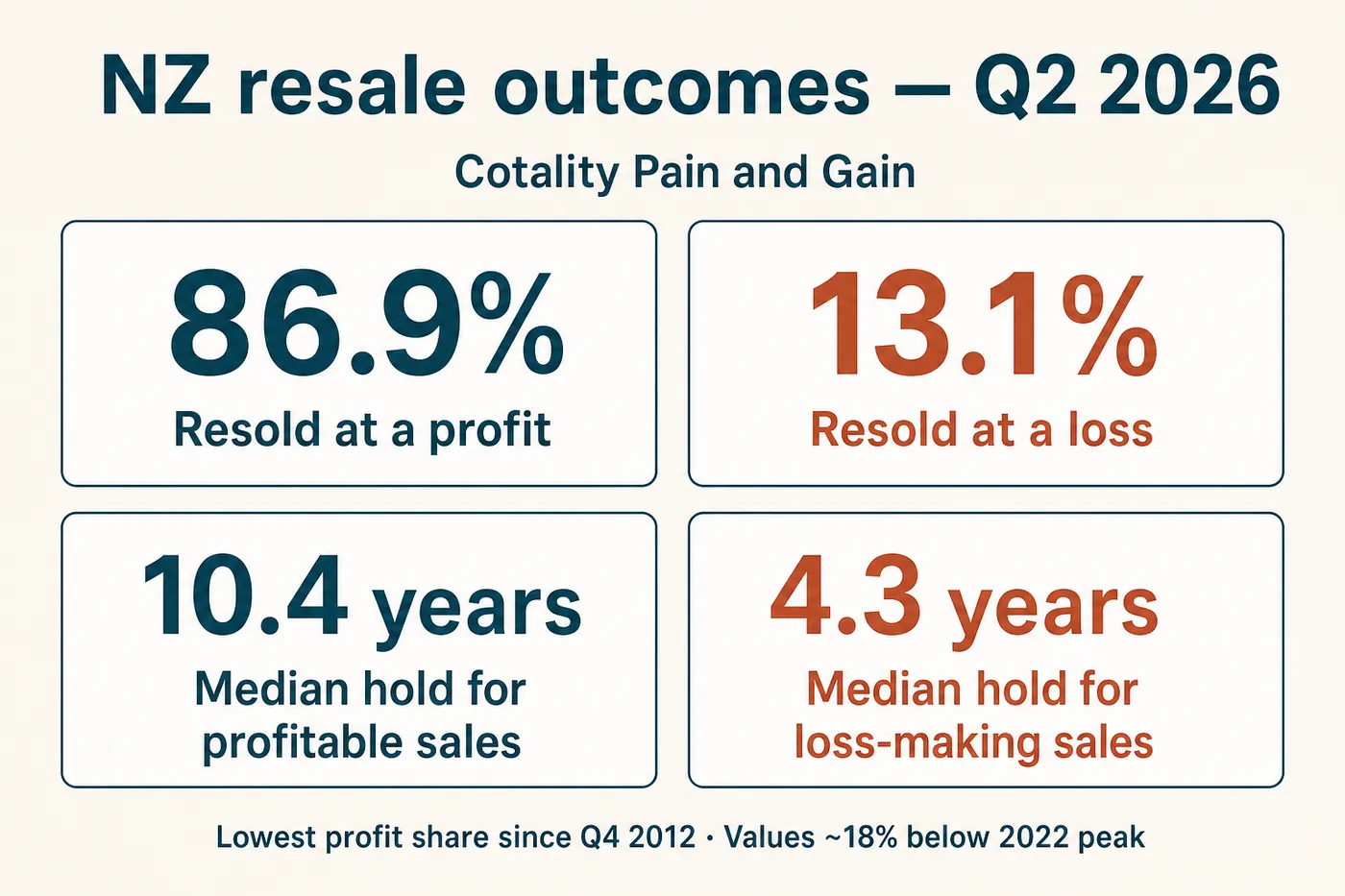
| Signal | Latest print | Why it matters |
|---|---|---|
| Profitable resales (Q2 2026) | 86.9% gain / 13.1% loss | Lowest gain share since Q4 2012 |
| Median hold (gains vs losses) | 10.4 years vs 4.3 years | Short holds are the loss cohort |
| REINZ July median / sales | $760,000 / 6,090 sales | −0.7% and −10% year-on-year |
| Days to sell (July) | 50 days | Budget extra holding cost on a flip |
| OCR (8 July 2026) | 2.50% | First hike of this cycle; servicing buffers matter |
Regional results still diverge. REINZ flagged West Coast and Gisborne as July standouts on median price (+14.7% and +9.6% year-on-year), while 13 of 16 regions recorded fewer sales. National averages hide street-level variance — which is why a flip in a thin resale pocket is a different trade from a hold in a high-yield regional town.
Why flipping is hard in August 2026
A property flip in New Zealand still needs one or more of three things: a real buy-in discount, tight value-add execution, or market uplift during the hold. In August 2026 the first condition is the one that shows up most often. The other two are less reliable. Cotality’s loss-making sellers had owned for a median of just 4.3 years — the 2022-peak cohort selling into a softer book. If your model assumes the next buyer will pay last cycle’s price, you are underwriting hope.
Contemporaneous on-selling has picked up from the 2023 trough, and RNZ has covered a lift in professional buyers passing discounted stock to other investors. That is not evidence that flipping is easy. It is evidence that motivated vendors exist and that skilled negotiators can still find equity. Nick Goodall at Cotality noted the activity remains well below pre-GFC peaks, and that it fails when buyers do not see value in the finished product.
Costs still compress error tolerance. Trade labour remains expensive; renovation overruns of 20% to 40% are common on poorly scoped jobs. Selling costs — commission often around 3–4% plus GST, plus legal, staging, and marketing — routinely consume a mid-single-digit share of after-repair value. Insurance, rates, and interest accrue for every extra week on site or on the market. In a 50-day median days-to-sell tape, those holding costs are not a rounding error.
Cosmetic, consent-light do-ups in deep buyer bands remain the flip path that still clears. Consent-heavy structural work stretches timelines into election and OCR uncertainty. For bang-for-buck scope, see which renovations actually pay in NZ. For why we score below $750k, see the sub-$750k value-add thesis.
Why holding is stronger right now
Holding does not require immediate capital growth. It uses today’s negotiating conditions, then earns time: rent, principal paydown, and the option to sell into a later cycle. Cotality’s profitable resales in Q2 2026 had a record 10.4-year median hold. Whether that is choice or necessity, the arithmetic is the same — resale profit becomes more likely as ownership lengthens.
Operating maths for holders improved on 1 April 2025, when 100% interest deductibility returned for qualifying residential rental borrowing. That does not rescue a weak yield, but it does stop the tax system from penalising leverage the way the phase-out years did. Earlier in 2026 Cotality reported national gross yields around 3.9% — the highest since 2015 — driven more by earlier value corrections than by booming rents. High-yield regional dwellings (gross yields often quoted above 6%) are the hold profile that can service debt without a price bounce.
The caveats are real. The OCR is 2.50% and the Reserve Bank has said further increases appear likely even if timing is uncertain. Council rates and insurance keep rising. A 7 November election adds policy risk on capital gains tax, bright-line length, and deductibility depending on the coalition. Hold quality assets that still cashflow if values stay flat — do not hold junk because “the cycle will save it.”
Screen both exits on the same listing
On Browse properties, scored NZ listings show flip ROI and rental yield side by side so you can see which exit the numbers actually support. Create a free account to save a watchlist; View pricing if you want full analysis depth.
How to decide: Flip ROI, yield, and a flat-value stress test
Flip ROI is the after-repair value minus purchase, renovation, and holding costs, divided by that same capital stack. FindMyProperty uses this screening identity — not a promise of your net tax result. ARV is estimated from comparable renovated sales; renovation is estimated from listing photos; holding costs are interest, rates, insurance, and utilities over the works and marketing window. Full method: how we score listings.
Gross yield is annual rent divided by purchase price. It is the hold filter: if yield cannot service realistic interest, rates, insurance, vacancies, and maintenance, you are a forced flipper whether you planned to be or not.
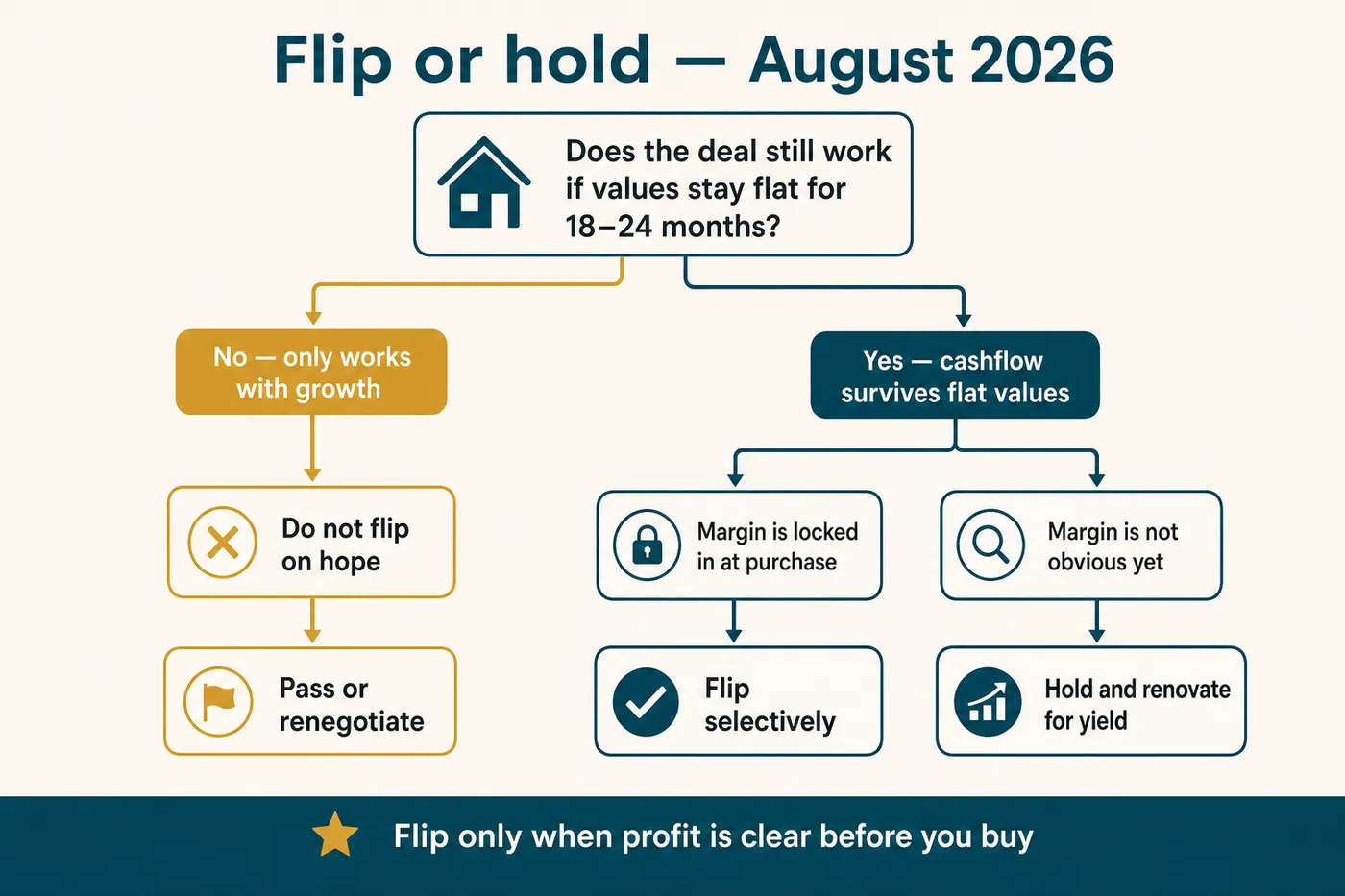
The 18–24 month flat-value test
Run every offer through one rule. If values stay flat for another 18–24 months, does the hold still cashflow after conservative rent, a vacancy allowance, and a higher servicing rate than today’s OCR? If yes, you can hold — and you can still sell later if a genuine flip margin appears. If no, you need a locked-in entry discount plus a renovation budget that does not depend on the market moving. A common servicing buffer is a debt-service coverage ratio around 1.20–1.25 at a stressed interest rate, not the current headline rate.
| Scenario | Primary recommendation | Why |
|---|---|---|
| Gross yield above ~6% in a regional rental market | Hold | Cashflow can carry the asset through a flat tape |
| Cosmetic do-up; margin clear before purchase | Flip selectively | Short execution; less consent and election-timeline risk |
| Consent-heavy structural works | Hold or pass | Holding costs and delay risk dominate flip maths |
| Below-market entry in a soft major centre | Value-add hold (BRRRR) | Lift rent and bank equity; wait for liquidity |
Tax that changes the exit: bright-line vs intention
New Zealand does not need a standalone capital gains tax for a flip to be taxable. For residential sales on or after 1 July 2024, the bright-line test is two years. Sell inside that window and the gain is generally income unless an exclusion applies. Sell after two years and you are outside bright-line — but not necessarily outside tax. If you bought with the purpose of resale, the intention test in the Income Tax Act (sections CB 6–7) can still assess the profit at your marginal rate, up to 39%.
Holders currently deduct 100% of qualifying rental interest (from 1 April 2025). That setting is a 2026 election issue. Labour has proposed a 28% tax on investment-property gains accruing from 1 July 2027; other parties have published longer bright-line, deductibility removal, or land-value tax ideas. Treat those as scenario risk, not as enacted law. The working detail is in our 2026 capital gains tax guide for property traders. Confirm your facts with an accountant before you set an exit date.
The practical investor takeaway
- If the deal still works with flat values for another 18–24 months, holding is the stronger default in this tape.
- If the deal only works with optimistic resale growth, your risk is elevated — that is a pass or a renegotiation, not a flip.
- Flip only when margin is clear before purchase, on a scope you can finish before extra days on market eat the buffer.
- Stress interest above 2.50% OCR, and do not underwrite a tax result you have not checked against bright-line and intention.
Bottom line
Hold quality assets. Flip selectively when the margin is obvious before you buy. Scores, ARV, and yield figures on FindMyProperty are screening estimates — not financial, tax, or legal advice.
Run the numbers on live listings
Browse properties ranks residential value-add and rental stock with flip ROI and yield on the same card. Create a free account for watchlists; compare View pricing when you want the full breakdown. Strategy question on a specific deal? Contact us.
Sources
- Cotality Pain and Gain Report — New Zealand Q2 2026 (August 2026)
- NZ Adviser — resale profits at a 14-year low (13 August 2026)
- NZ Adviser / REINZ — July 2026 sales, median, days to sell, election caution (13 August 2026)
- RBNZ — OCR increased to 2.50% (8 July 2026)
- RNZ — contemporaneous sales / professional flipper activity
- Inland Revenue — the bright-line test (two-year standard from 1 July 2024)
- FindMyProperty.co.nz — flip ROI and rental yield screening models (estimates only).
Frequently Asked Questions
Is flipping still possible in the NZ market in August 2026?+
Yes, but it is less forgiving. Cotality’s Q2 2026 Pain and Gain report shows 13.1% of resales at a gross loss, and the median loss-making seller had held for only 4.3 years. Flips still work where the buy-in discount and renovation budget protect margin without relying on market uplift.
Why does hold period matter for flip vs hold?+
In Q2 2026, profitable resales had a record 10.4-year median ownership period, versus 4.3 years for losses. Short holds that bought near the 2022 peak are the cohort most exposed. Time in the asset is still the strongest buffer against a down cycle.
Why does high listing stock matter for investors?+
Elevated stock improves buyer choice and negotiating power on the way in, but it also limits resale urgency and pricing power for short-hold projects. That is why entry discount matters more than a hoped-for spring rebound.
What should I stress-test before deciding to hold?+
Model cashflow and yield under conservative rent, include rates, insurance, and maintenance, and test whether the asset still performs if values stay flat for 18–24 months. After the 8 July 2026 OCR lift to 2.50%, also stress interest at a higher servicing rate than today’s headline.
Does the two-year bright-line test mean a flip is tax-free after 24 months?+
No. Bright-line taxes many residential investment sales within two years of the start date for sales on or after 1 July 2024, but the intention/purpose test can tax a profit-driven flip regardless of hold period. Confirm structure with your accountant before you buy.
How does FindMyProperty screen flip vs hold?+
Listings are scored with renovation estimates from listing photos, flip ROI against after-repair value, and rental yield from market rents. That is a screening layer so you can compare exits — not a substitute for a valuation, LIM, or tax advice.
See it in action
Browse AI-scored NZ investment properties with full financial breakdowns.
Browse propertiesMore ways to get started
Plans, local team contact, and background on who builds FindMyProperty.
More Articles
NZ's Building Rebound: Residential Activity Up 4.4%, Consents Up 21% — What It Means for Property Investors
Residential building activity rose 4.4% in the June 2026 quarter, and 41,268 new homes were consented in the year to August, up 21%. House values are still falling.
Read →📊NZ Property Market Outlook September 2026: Why Long-Term Investors Are Still Buying
Listings hit a 12-year August high and Cotality’s median is under $800k, about 18% below the 2022 peak. Here’s why long-term NZ investors are still running the numbers.
Read →