NZ Property Market Outlook September 2026: Why Long-Term Investors Are Still Buying
Listings hit a 12-year August high and Cotality’s median is under $800k, about 18% below the 2022 peak. Here’s why long-term NZ investors are still running the numbers.
September 2026 · Naysayers
The headlines aren’t wrong. They’re just not the whole story. Listings on realestate.co.nz hit a 12-year high for August. Asking prices have fallen for six months in a row. The Reserve Bank lifted the OCR to 2.75% on 2 September. Cotality has the national median under $800,000 — about 18% below the 2022 peak. That’s a tough spring. It is not a broken market.
NZ property market outlook in September 2026 is a choice about discipline, not a bet that prices bounce next quarter. If you have read the property pages this month you know the tone. None of that is made up. It is a genuinely tough selling season. Anyone telling you otherwise is not reading the same figures we are.
This is written for value-add investors and yield-focused holders who still want to buy when the mood is ugly. First-home buyers matter as part of the resale pool in the cheaper bands; they are not the audience. Zoom out from this week’s headlines to the last five decades of New Zealand cycles and this moment looks more familiar than it feels. Then screen live scored listings on Browse properties.
What the NZ property market is doing this spring
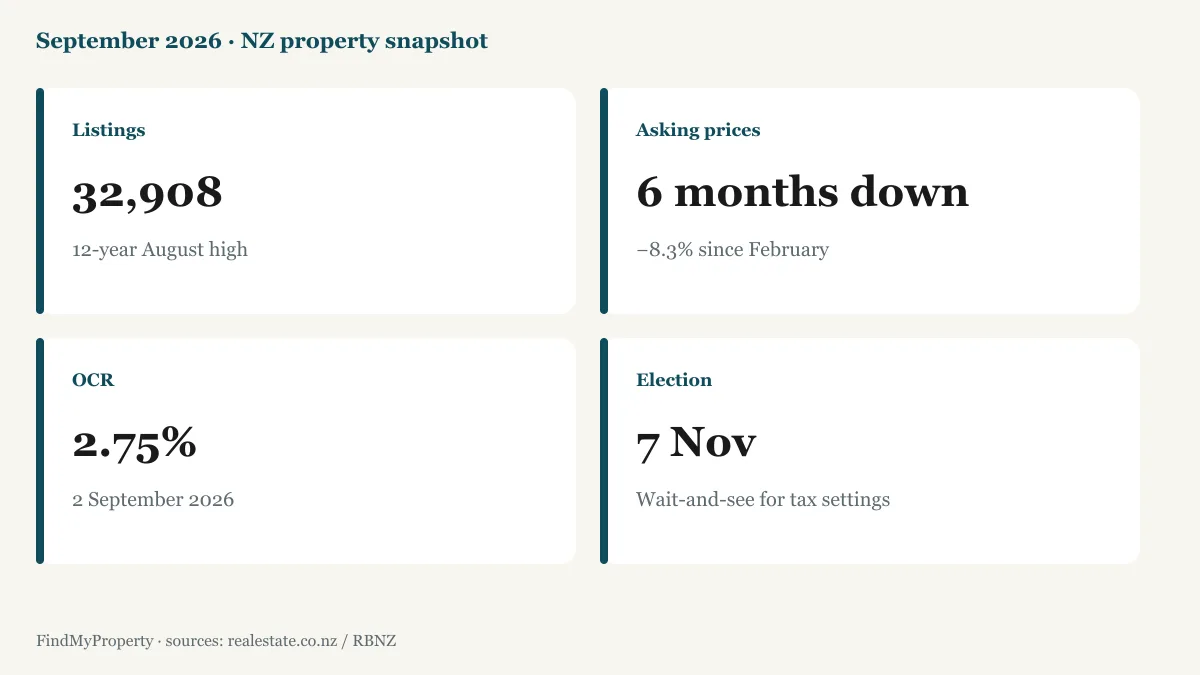
Realestate.co.nz finished August with 32,908 homes for sale — a 12-year high for this time of year, and more than double the boom year of 2021. Asking prices on that series have now fallen for six months in a row and are down 8.3% since February.
Cotality’s August Home Value Index put the national median at $797,944, down 0.4% on the month — the fifth drop in a row — and about 18% below the 2022 peak. REINZ’s August sales were 5,430 (−13% year-on-year), the national median sale price $750,000 (−1.3%), and 51 days to sell. The Reserve Bank lifted the OCR to 2.75% on 2 September, the second hike after 8 July. The general election is 7 November. Plenty of investors are sitting on their hands.
| Signal | Latest figure | Why it matters |
|---|---|---|
| Listings (end-August) | 32,908 · 12-year August high | More choice; vendors still competing |
| Asking prices | Six months down · −8.3% since February | Room to negotiate on the way in |
| Cotality median (August) | $797,944 · −0.4% month · ~18% below peak | Fifth monthly fall; not a crash from here |
| From peak (Cotality via RNZ) | Auckland −24.5% · Wellington −27.2% · Christchurch −1.3% | National headlines hide the split |
| REINZ August | Median $750,000 · 5,430 sales · 51 days to sell | Slow, selective, wait-and-see |
| OCR | 2.75% from 2 September 2026 | Stress the deal above today’s cash rate |
We’ve been here before. Several times.
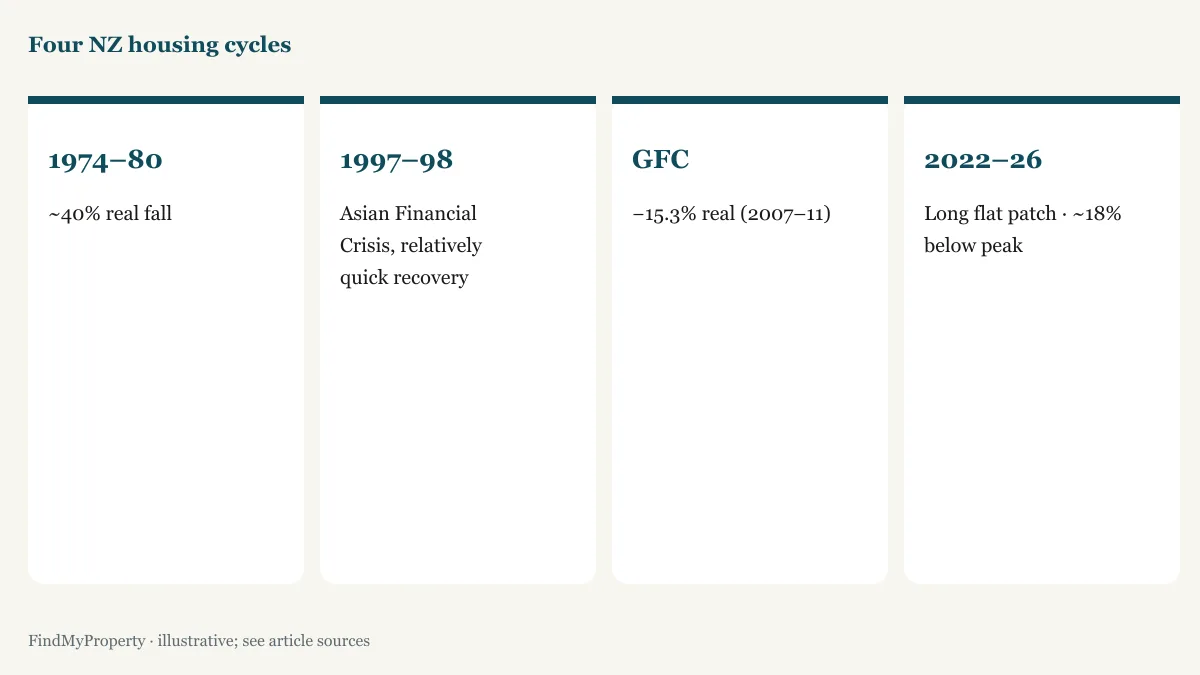
The pattern is drearily consistent: a shock or a tightening cycle, a fall that feels like it will never end while you are in it, a grind, then a recovery that looks obvious only in hindsight. Nobody rang a bell at the bottom in 1980, 1998, or 2009 either.
| Cycle | What happened | Investor read |
|---|---|---|
| 1974–80 | Oil shock, migration turned negative. Real house prices fell about 40% over six years; in dollar terms they went sideways while inflation ate them. | The first modern grind. Nominal “flat” can still hurt in real terms. |
| 1997–98 | Asian Financial Crisis after a hot mid-90s run. Several regions went backwards. Most cities were growing again by about 2000. | Ugly and fast, then a relatively quick recovery. |
| GFC 2008–11 | Real house prices fell 15.3% from 2007Q2 to 2011Q2. Not as dramatic as people remember. The slow years after were still long. | Nationally shallower than the 1970s. Time in the asset still did the work. |
| 2022–26 | Fastest OCR tightening on record unwound the post-Covid boom. Cotality and economists now talk about one of the longest flat patches in the modern data. Wellington is a long way below peak; Christchurch is barely off it. | Longer than the GFC even if it is not the deepest everywhere. |
What the forecasts actually say
Strip out the scare headlines and look at what the institutions are actually writing down. The Reserve Bank’s September 2026 Monetary Policy Statement has house prices falling a bit in 2026, then a modest recovery — not a collapse. RNZ reported that update as implying about another 1% nationally over the next 12 months. That is their read of the Bank, not a year-by-year table we are republishing.
Treasury’s Budget Economic and Fiscal Update (28 May 2026) has house prices rising at an average 3–4% a year over the forecast. That replaced the old 6–7% path. Bank economists called 7–10% growth for 2025; Cotality’s calendar 2025 was −1.0%. Treat point forecasts as weather, not a business plan.
Since 1992, New Zealand house prices have risen about 6% a year on average, according to ANZ’s May 2026 Property Focus. That already has the 1997 wobble and the GFC in it. A downturn like this one does not wipe three decades of compounding. It is a chapter in it. For flip versus hold maths in this market, see our August 2026 flip-or-hold guide. For where scored sub-$750k listings still model a renovation margin, see the August housing-market cut.
Run the numbers on live listings
Headlines do not run the numbers on 12 Example Street. Browse properties scores residential value-add and rental listings with flip ROI and yield on the same card. Create a free account for watchlists.
Why the numbers matter more when the mood is ugly
None of this is an argument for buying anything, anywhere, on the theory that time heals all deals. Wellington’s structural issues — public-sector job losses, expensive infrastructure repair bills — are not going away just because the cycle turns. Some of the “cheap” listings out there are cheap for reasons that will not fix themselves.
That is the whole case for keeping at it right now. Not optimism — arithmetic. Long-term investors are not trying to call the exact bottom. They are trying to be in deals that still stack up on cashflow and due diligence before everyone agrees the bottom has passed, because by then the discount is gone. Every cycle in this country has rewarded the people who kept looking properly through the quiet, ugly middle, and punished the people who waited for the headlines to turn before they started.
The practical investor takeaway
- If the deal still works with flat values and an OCR at 2.75% or higher, you can keep buying — slowly, and only what stacks up.
- If the deal only works if prices bounce before the election, that is a pass.
- Do not treat Wellington (or any cheap listing) as a cycle trade if the local jobs and capex story is broken.
- Tax after 7 November is a scenario. Model it; do not freeze a conservative hold for a poll. Detail in our 2026 capital gains tax guide for property traders.
Bottom line
The market will feel like this for a while yet. That is not a reason to stop. It is a reason to be fussier about which deals you say yes to — not fewer looks, better-scrutinised ones. FindMyProperty scores are a screen, not financial, tax, or legal advice.
Keep looking, properly
Browse properties ranks residential value-add and rental listings with flip ROI and yield. Create a free account for watchlists; compare View pricing when you want the full breakdown. Strategy question on a specific deal? Contact us.
Sources
- interest.co.nz — realestate.co.nz August listings 32,908, 12-year high, asking prices six months down (1 Sep 2026)
- Cotality — August 2026 Home Value Index, median $797,944, fifth monthly fall, ~18% below peak
- RNZ — longest flat patch, Auckland/Wellington/Christchurch from peak, RBNZ ~1% commentary (Sep 2026)
- Scoop / REINZ — August 2026 median $750,000, 5,430 sales, 51 days to sell (15 Sep 2026)
- RBNZ — Official Cash Rate 2.75% from 2 September 2026
- interest.co.nz — OCR lifted to 2.75%, modest house-price recovery wording
- Treasury — BEFU 28 May 2026, house prices 3–4% average (revised from 6–7%)
- ANZ Property Focus May 2026 — about 6% a year since 1992
- RNZ — why 2025 house-price forecasts (7–10%) were wrong
- Cotality — calendar 2025 values −1.0%
- Greater Auckland — 1974–80 real house prices about −40% (RBNZ long-run series)
- Grimes / academic GFC paper — real prices −15.3% 2007Q2–2011Q2
- FindMyProperty.co.nz — flip ROI and rental yield screening models (estimates only).
Frequently Asked Questions
Is now a good time to buy an investment property in New Zealand?+
It can be, if the deal still stacks up with flat values and a 2.75% OCR — not because you timed the exact bottom. August left 32,908 listings on realestate.co.nz, a 12-year high for the month, and Cotality has national values about 18% below the 2022 peak. That is more choice and more room to negotiate. It is not a reason to buy a listing that is cheap for a reason. Screen scored residential listings on FindMyProperty, then do your own due diligence.
What is the NZ property market doing in September 2026?+
It is a tough, slow spring. Asking prices on realestate.co.nz have fallen for six months in a row. Cotality’s August median was $797,944, down 0.4% on the month and the fifth drop in a row. REINZ recorded 5,430 August sales (−13% year-on-year) and a $750,000 national median (−1.3%), with 51 days to sell. The Reserve Bank lifted the OCR to 2.75% on 2 September. Investors are in wait-and-see mode ahead of the 7 November election.
How far are NZ house values below the 2022 peak?+
About 18% nationally, according to Cotality’s August 2026 Home Value Index. RNZ, citing Cotality, put Auckland 24.5% below peak, Wellington 27.2%, and Christchurch only 1.3%. The national median sitting under $800,000 is a three-year-style low in level terms — most of the heavy fall was 2022–23, and the years since have been a grind.
Does the OCR rise to 2.75% mean investors should stop buying?+
No. It means stress the deal above 2.75%, not below it. The 2 September lift was the second hike after 8 July’s move to 2.50%. Servicing is tighter than the mid-year cash-rate low. If the yield and cashflow only work on a hopeful cut, that is a pass. If they still work with a higher rate and flat values, the cash rate is a cost to model — not a stop sign.
Should I wait until after the 7 November 2026 election?+
Plenty of investors are doing exactly that, and REINZ members have said so. Waiting for the headlines to turn is how you miss the discount. Tax settings can change — Labour has talked about a tax on investment-property gains from 1 July 2027; that is a scenario, not law. Run the numbers both ways, and read our capital gains tax guide for traders. Do not freeze a good, conservative deal for a poll.
Does a long downturn mean any cheap listing is a buy?+
No. Wellington’s public-sector jobs and infrastructure bills are not going to vanish because the cycle turns. Some cheap listings are cheap because the yield, the capex, or the location does not work. That is why the numbers matter more when the mood is ugly: the deals that stack up get mispriced next to the ones that do not. FindMyProperty scores are a screen, not a valuation or advice.
See it in action
Browse AI-scored NZ investment properties with full financial breakdowns.
Browse propertiesMore ways to get started
Plans, local team contact, and background on who builds FindMyProperty.
More Articles
NZ Housing Market in August 2026: Value-Add Renovation Play
July sales fell 6.4% and values sit 17.7% below peak. FindMyProperty’s scored sub-$750k book: 76 listings still model 15%+ flip ROI.
Read →📊How We Score NZ Investment Properties in 2026
FindMyProperty's composite score is 45% ROI, 17.5% timeline, 17.5% confidence, 20% location. Verdict bands, reno $/m², and what the score cannot see — August 2026.
Read →