Trains, pipes, planners and premiums: the four forces redrawing Auckland's investment map
October Auckland sales fell 30% and the median price fell 7.6%. The City Rail Link is open, but insurance, zoning and growth charges now differ by street.
Direct answer · November 2026
The City Rail Link is carrying record crowds. Auckland sales are not. REINZ recorded Auckland sales down 30% in October 2026, and the regional median price down 7.6%. Trains and zoning lift some streets. Pipes, fast-track supply and insurance charges cap others. Price the street. Screen the house on Browse properties, then do the hazard work this note sets out. We do not score flood.
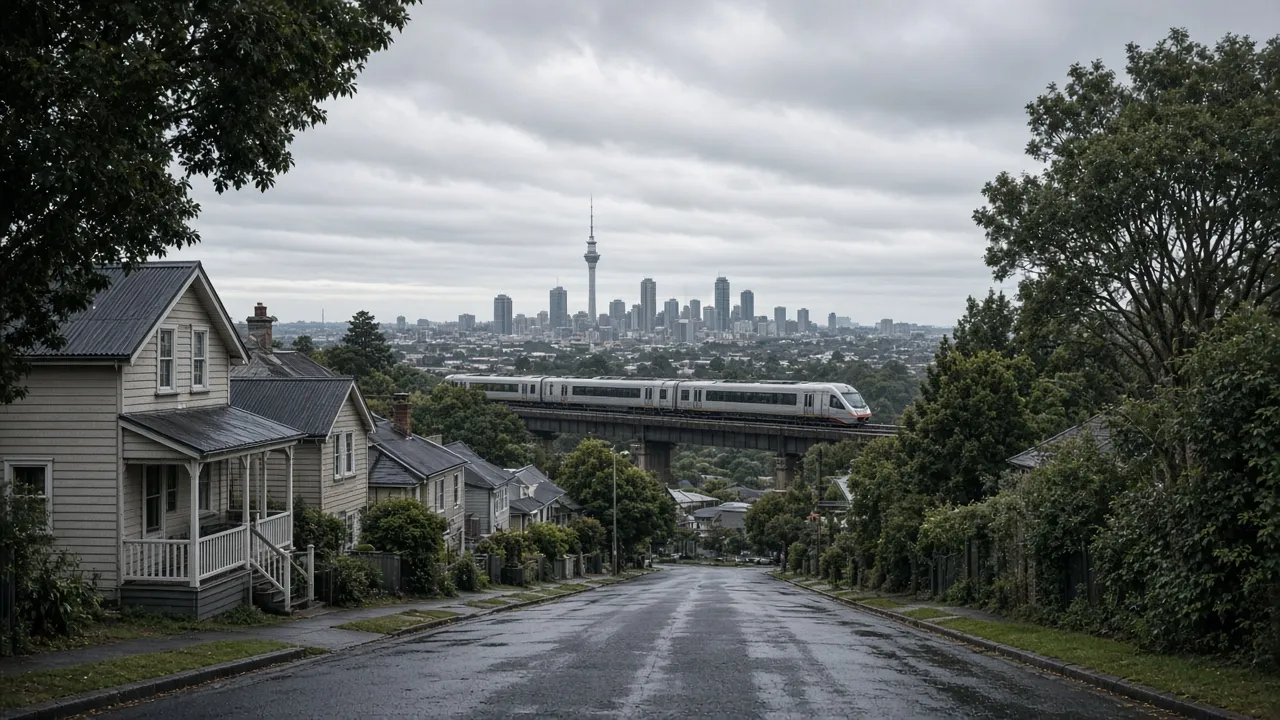
On Sunday 13 September 2026 the City Rail Link opened to passengers. In the seven days from 13 to 19 September, 1News reported 528,007 train boardings. That was about 62% more than the week before, and a new weekly record, past the March 2019 high of 504,380. The project is the $5.5 billion tunnel. Te Waihorotiu, Karanga-a-Hape and a rebuilt Maungawhau are open. Waitematā is no longer the end of the line.
House prices did not rise to meet it. interest.co.nz's report of the REINZ October figures, published 13 November 2026, shows 5,840 sales nationwide, down 23.5% on October 2025. Auckland sales were down 30% on a year earlier, and 7.3% on September. The national median was $763,000, down 3.4%. Auckland's median was down 7.6%. The House Price Index rose 0.1% in the month and was down 2.1% on a year earlier. REINZ chief executive Lizzy Ryley said greater choice was letting buyers take their time, and that some vendors and buyers were measured ahead of the election.
The cash rate is not a tailwind you can pencil in as a cut. On 28 October 2026 the Reserve Bank held the OCR at 2.75%, by four votes to three. The committee agreed that tighter policy is likely to be required, and that this remains conditional on the outlook. The next Monetary Policy Statement is at 2pm on 9 December 2026. Annual inflation was 3.7% in the September quarter.
Some of the slow market is the cycle. A good deal of the Auckland map is structural. Four forces are pulling at once. Trains and zoning raise the ceiling on some sites. Water and funding rules change what growth costs. Fast-track consenting changes what gets approved, and where. Insurance and hazard ratings are starting to set a floor under other sites. They do not all point the same way.
Where does the City Rail Link actually add value?
Patronage is not a price. OneRoof has reported CBRE's finding that Auckland residential values rose 29% in the decade to 2024, while values within station catchments rose 36%. The same coverage warns that working from home could limit future gains, and that a weak market can mask them. CBRE's own note on the project expects a modest overall uplift, stronger around the new city-centre stations, at Maungawhau, and where planning rules allow denser redevelopment.
That last condition is the one you can underwrite. In July the council's planning committee voted 17–5 to take an amended Plan Change 120 back out for submissions. 1News reported six storeys along bus corridors including Dominion, Sandringham, Great North and Onewa roads, and 10 to 15 storeys around metropolitan centres and stations such as Ōrākei, Remuera and Glen Innes, on top of the inner-west stations the Government had already required the council to upzone. RNZ noted an exception at Meadowbank, where the proposal cuts heights to six storeys because of the valley and poor access.
Auckland Council's account is more precise than a suburb label. The Government cut the minimum housing capacity the council must enable from around two million homes to 1.4 million. The current Unitary Plan is estimated at about 1.2 million homes of theoretical capacity. The proposed changes are estimated at about 1.5 to 1.7 million. That is not a build target. About 85% of the urban area stays on the current Unitary Plan rules. Walkable catchments outside 10 kilometres of the city centre generally drop back to the six storeys the Government requires. The same plan strengthens natural hazard rules so fewer new homes go into high flood risk.
The extra submissions round closed at 5pm on 24 September 2026. An independent hearings panel considers them. The council expects final decisions in mid-2027. Until those decisions, a station within walking distance is a convenience. A station within walking distance of land that can legally carry several storeys is an option. The map that lifts one street can cap the next.
South of the isthmus, Auckland Transport opened new stations at Drury and Paerātā on 2 August 2026. New platforms do not, on their own, tell you the zoning, the flood overlay, or who pays for the pipes.
Who pays for the pipes?
Announcement is not delivery. 1News's February report of the Infrastructure Commission's first National Infrastructure Plan put nearly 12,000 projects and a combined $275 billion in the pipeline, with more than two-thirds not yet fully funded. Replacing and renewing what is already built was put at about 60 cents of every infrastructure dollar over the next three decades. The Commission's view, as reported there, was that Roads of National Significance, major public transport projects such as the Northwestern Busway, and another harbour crossing together exceed the revenue likely to be available. A funded job under construction is a different asset from a line on a thirty-year schedule.
Water is where that lands on a feasibility. Watercare is financially separate from the council. From 1 July 2026 it lifted infrastructure growth charges by 20%, which it said was the minimum its settings require. Household water and wastewater prices rose 7.2% at the same time. For a new dwelling on the metropolitan schedule, the combined water and wastewater infrastructure growth charge is $29,348.46 including GST, up from $24,457.05. That figure is the metropolitan rate Watercare applies across metropolitan Auckland, including Papakura. It is paid at connection. It is not the council development contribution. A dwelling of 65 square metres or less may qualify for a reduced rate. Towns on the northeast and southwest schedules, and several rural schemes, are higher. Use the schedule for the site.
Where the public network is tight, fast-track projects are bringing their own pipes. The Government's August release on Delmore, at Ōrewa, covers more than 61 hectares and over 1,200 homes. The panel accepted private water and wastewater because of constraints on the public network. Treated wastewater in the first stage is discharged on site, with off-site transport in summer when needed. The second stage waits on a long-term wastewater solution. Sunfield, at Ardmore, is about 3,850 homes, approved on the basis that the project funds the upgrades it needs. None of that is free. The party that funds the pipes recovers the cost, and it turns up in the price of the sections.
A score is not a hazard check
FindMyProperty scores listed New Zealand houses and do-ups. It does not score flood, and it does not sell insurance. Create a free account if you want a watchlist of scored residential listings. Read how we score listings and landlord insurance for NZ investors before you treat a score as a clean bill of health.
What does fast-track change for existing houses?
The Fast-track Approvals Act is now a real source of Auckland housing approvals. The large ones cluster at the urban edge and in a few redevelopment sites: Sunfield at Ardmore, Kiwi Property's Drury metropolitan centre, Milldale, Delmore at Ōrewa, a two-tower rebuild of the Downtown carpark, and a retirement village at Mission Bay. Build-out on the big housing projects runs over 10 to 15 years. An approval is not a construction programme, and it is not a reason to assume today's resale price in that catchment stays put.
The argument is about who pays when houses are approved ahead of the council's funding plan. In August the Government said councils could update development contribution policies after a fast-track application is made. Simpson Grierson notes those updates have to be adopted within six months of an approval. A replacement levy system is expected from 2029. Local Government New Zealand has said the change comes too late for developments already approved or referred. For anyone modelling a new dwelling, charges on new homes are more likely to rise than fall. For anyone buying an existing house in the same catchment, the relevant question is how much competing supply is actually funded.
The planning statute is changing underneath Plan Change 120. The Planning Act and the Natural Environment Act, which replace the Resource Management Act, received Royal assent in late September 2026. Each region is to get a combined plan built around a regional spatial plan, covering housing, infrastructure and natural hazards among other things. Draft spatial plans are due to be notified in 2028, with the new system expected to be fully operational through 2029 and 2030. Until then, councils keep processing consents under the old Act. Plan Change 120 will be decided inside a system that is itself being replaced. Do not treat a 2026 zone map as permanent.
How is insurance starting to price the floor?
If infrastructure raises the ceiling, insurance is starting to set the floor. A Treasury cabinet paper from 28 January 2026, ECO-26-SUB-0003, says home insurance premiums have grown at three times the rate of general CPI since 2011, including a 40% rise in the last two years. Premiums have grown faster still for some people in high-risk areas. The paper says insurance remains largely available, and that access is becoming more difficult where earthquake and flood risk overlap.
Auckland has had some relief off a high base. RNZ reported Consumer NZ's February survey: the median premium for a large Auckland house had fallen 11% on a year earlier, while Wellington and Christchurch rose 10%. That fall followed the spike after the 2023 floods and Cyclone Gabrielle. A separate RNZ report said Treasury data showed premiums fell in every region in the year to October 2025, while high flood-risk locations still drew extra premiums of thousands of dollars in some cases, and about twice as many rejected online quotes as places with no flood risk. A regional median can fall while one street becomes hard to place.
Availability is the sharper risk. AA Insurance has temporarily paused new home and landlord policies in a small number of areas. Reported pauses include Westport for flood, Lincoln and Rolleston for earthquake exposure, and Blenheim. The insurer has said the pauses are temporary and that existing customers are unaffected. The places named so far are outside Auckland. The pattern still matters. MinterEllison has called it postcode insurance, where cover is limited by area rather than by the house in front of you. Insurance Business reported in October that a government report projects around 10,000 homes could become hard to insure from 2035. That is a projection, not a list of Auckland streets.
The Natural Hazards Commission covers the first layer, up to $300,000 plus GST for a home. The same Treasury paper says the current levy of 16 cents per $100 of cover is below the 24 cents needed to meet the scheme's long-run costs, which would lift the maximum annual levy per dwelling from $554 to $828 including GST. Ministers paused that increase so it could be lined up with work on insurance affordability. The cabinet minute says the levy review is to restart no later than the 2027/28 financial year. Do not underwrite a deal on the hope that the levy gets cheaper, or that the Government steps in to cap your premium.
Which hazard score are you actually reading?
The scales do not match. A clean result on one is not a clean result on the others.
- LIMs. Amendments from 2025, and regulations that took effect on 17 October 2025, require a natural hazard section on a LIM, including cumulative risks. Anderson Lloyd sets out what owners need to read.
- The council's 2023 storm categories. As at 19 February 2026, Auckland Council had categorised 1,977 properties as Category 1, 139 as 2P, 32 as 2C and 1,201 as Category 3. Category 3 is intolerable risk to life that cannot reasonably be reduced. That programme is not a score for every Auckland house. The recovery update said the office was moving to close on 30 June 2026, with about 1,200 Category 3 properties staying in council ownership while future land use is decided.
- Cotality's flood score. On 18 November 2026 Cotality published a score from 0 to 5 for every New Zealand home, combining river, surface and coastal flooding. Homes in the higher bands, scores 3 to 5, number about 24,000 in Christchurch, 13,900 in Napier, 11,300 in Auckland City and 10,400 in Lower Hutt. Auckland City is not the whole region. A zero is not a guarantee you will not flood.
- Insurer models. Westpac says that since July 2026, customers applying for home insurance in its app can see Tower's property-level hazard information. Tower prices new policies using flood, earthquake, sea-surge and landslide risk at the address.
- A national map. The Ministry for the Environment is due to publish a national flood map in 2027. Until it is out, you are comparing council maps, LIMs and private scores.
Buyers have so far paid up for the cheaper flood-exposed stock. Cotality's July 2026 note says homes with a FloodScore of 5 rose 26.1% from January 2020, against 19.8% for homes with a score of 0. In Auckland, values in flood-affected pockets were 18.4% above 2020, against 13.0% in nearby buffer areas. Cotality's Craig Dargusch put the mechanism plainly: insurance availability is becoming the way climate risk gets priced, because a mortgage generally needs insurance. Past outperformance is not a reason to ignore a score of 5.
The lending change is newer than the scores. From 11 November 2026, Westpac gives home-loan applicants a short Natural Hazard Risk Insights report, using data from ClimSystems Powered by SLR, and uses the same data in the lending decision. It says it is not moving to risk-based pricing and does not expect to decline applications on hazard alone. In a small number of cases the amount it will lend may be lower than it would have been. RNZ reported that this is no more than about 2% of cases, and that the bank may cut the loan amount or shorten the term, for example from 30 years to 25. Existing customers are not reassessed for hazard when they refix. Westpac's Greater Choices top-up offers up to $50,000 at 0% for five years for listed work such as drainage and raising services. An owner-occupier needs at least 20% equity after the top-up. An investment-property owner needs 30%. It is not automatic, and it is not a substitute for insurance.
Put together, insurability is becoming a condition of finance, and finance is a condition of who can buy from you later. A house that cannot be insured at a sensible price, or financed at a normal loan-to-value ratio, has a smaller pool of buyers when you sell.
Where do these forces collide?
None of this makes Auckland uninvestable. It makes a regional median less useful. One station catchment can hold a ridgeline street that is upzoned and straightforward to insure, and a low-lying street that faces a hazard overlay, a higher premium and a more cautious lender.
| Lower hazard | Elevated hazard | |
|---|---|---|
| Strong access, upzoned | Often already priced for the station and the height. Best development option. Check you are not paying today for infrastructure that is still years away. | The value-trap case. Zoning upside can be offset by insurance cost and a lower loan. Stress-test the exit. |
| Weaker access | A yield and fundamentals case. Watch fast-track supply at the urban edge, and put today's growth charges in the model. | The hardest case. Insurability and resale liquidity are the questions, before the renovation margin. |
With Auckland sales down 30% on a year earlier, buyers have more room to ask for the LIM, the quote and the lender's view, and to price what comes back. A slow market is when that work is worth doing. It is not a reason to skip it.
What should you watch from here?
- 27 November 2026: the official election result. Informal talks have already started. National and New Zealand First have said formal negotiations wait for that count. The next government will shape insurance settings, the Natural Hazards levy, fast-track and the planning transition. This note does not pick a winner.
- 9 December 2026, 2pm: the Reserve Bank's Monetary Policy Statement and OCR decision. October's vote was 4–3 to hold at 2.75%. The committee said tighter policy is likely, and conditional. Do not assume a cut.
- 2027: the Ministry for the Environment's national flood map.
- Mid-2027: council decisions on Plan Change 120, after the hearings.
- 2027/28: the Natural Hazards levy review is due to restart.
- 2028 to 2030: draft regional spatial plans, then the new planning system.
- 2029: the expected start of the development levy that replaces today's contributions.
- Any time: whether another bank follows Westpac and shows hazard data on a home-loan application.
What can you do before you bid?
- Get an insurance quote before you go unconditional. Ask for landlord cover, not only an owner-occupier policy, and shop it. Consumer NZ has put the median gap between like-for-like quotes at about $550.
- Read the LIM's natural hazard section and the council flood maps, then a property-level score. A clean result on one scale does not clear the others. The Cotality count of 11,300 is Auckland City homes in the higher bands. It is not your LIM.
- Ask the lender how hazard data affects the loan amount, the term and the loan-to-value ratio. Westpac has said what it is doing. Do not assume every bank is doing the same thing in silence, and do not assume none of them are.
- Underwrite the zone, not the distance to the station. Check Plan Change 120's proposed zone and hazard overlay for the address. Treat the mid-2027 decision as still live.
- Put current growth charges in every new-dwelling feasibility. On the metropolitan schedule that is $29,348.46 including GST to Watercare alone, before council development contributions. Check the 65 square metre concession if it applies.
- Stress-test the cash flow with insurance at a multiple of today's premium, and the exit with a smaller buyer pool.
- Budget for drainage, raised services or retaining if the report supports it, and keep the invoices. Westpac has said mitigation can be taken into account. Another lender may not.
Location still decides much of what a house is worth. Location now has more layers than a postcode: access, zoning, servicing, hazard and insurability. The Auckland deals that still work are the ones that price all five, not the ones that buy a suburb because a station opened.
See the live listings
Browse properties is where you look at scored houses. View pricing is where the full detail sits. Contact us if you have a question about a specific deal. We score listed New Zealand houses and do-ups. We do not score commercial property, and we do not quote insurance.
Sources
- City Rail Link breaks Auckland train patronage records, 1News, 21 September 2026. First-week boardings 528,007.
- REINZ October housing market data, interest.co.nz, 13 November 2026.
- OCR held at 2.75%, Reserve Bank of New Zealand, 28 October 2026. Next statement 9 December 2026.
- City Rail Link warning, OneRoof, reporting CBRE. CBRE's project note.
- More intensification option wins out, 1News, 22 July 2026. Council vote, RNZ. What was approved, OurAuckland. Further submissions closed 24 September 2026.
- Drury and Paerātā stations, Auckland Transport, opened 2 August 2026.
- National Infrastructure Plan, 1News, 17 February 2026.
- Watercare pricing from 1 July, 3 June 2026. Metropolitan infrastructure growth charge $29,348.46 including GST for 2026/27.
- Cabinet paper ECO-26-SUB-0003 and minute ECO-26-MIN-0003, Treasury, 28 January 2026. Levy 16 cents versus a recommended 24 cents.
- Westpac hazard reports for home-loan applicants, 11 November 2026. RNZ on how the loan can change. Greater Choices, up to $50,000 at 0% for five years.
- Cotality flood hotspots, 18 November 2026. Value growth and flood scores, 7 July 2026.
- 2023 storm categories as at 19 February 2026, OurAuckland.
- How we score NZ investment properties. Landlord insurance for NZ investors.
This is general information as at 21 November 2026. It is not financial, legal, insurance or tax advice. Figures are from the sources above and can change. Official election results were not out when this was published. The 9 December OCR decision had not been released. FindMyProperty scores listed New Zealand houses and do-ups. It does not sell insurance. It does not score flood risk. It does not score commercial property. Check the current LIM, a current quote and a lender before you bid.
Frequently Asked Questions
Did the City Rail Link lift Auckland house prices when it opened?+
Not in the October 2026 REINZ figures. The line opened to passengers on 13 September 2026. In its first week Auckland recorded 528,007 train boardings, about 62% more than the week before. REINZ then recorded Auckland sales in October down 30% on a year earlier, and the regional median price down 7.6%. OneRoof has reported CBRE work showing stronger value growth in station catchments over the decade to 2024, with a warning that working from home and a weak market can limit the next gain. A station is a convenience. Zoning that lets the site go up is the option the market can price.
What did Auckland house sales do in October 2026?+
REINZ recorded Auckland sales down 30% on October 2025, and 7.3% lower than September. The Auckland median selling price was down 7.6% on a year earlier. Nationally there were 5,840 sales, down 23.5% on a year earlier. The national median was $763,000, down 3.4%. The House Price Index rose 0.1% in October and was down 2.1% on a year earlier. REINZ said some buyers and vendors were measured ahead of the general election. These are market figures. They are not a verdict on one street.
Where is Auckland Plan Change 120 up to?+
In July 2026 the council voted 17–5 to notify an amended Plan Change 120. It keeps taller housing near the city centre, metropolitan centres, train stations and some bus routes, and it tightens rules where flood and other natural hazards are high. Auckland Council says about 85% of the urban area would stay on current Unitary Plan rules. The extra submissions round closed on 24 September 2026. An independent panel hears submissions. The council expects to make final decisions in mid-2027. Until then, treat the maps as a proposal, and check the address.
What does a new Auckland dwelling pay Watercare to connect?+
From 1 July 2026 the metropolitan combined water and wastewater infrastructure growth charge is $29,348.46 including GST per residential unit. That is a 20% rise, which Watercare said was the minimum under its settings. It is paid at connection, before Auckland Council development contributions. A dwelling of 65 square metres or less may qualify for a reduced rate. Northeast, southwest and some rural towns are on higher schedules. Use the schedule for the address, not the metropolitan figure, if the site is outside it.
How is Westpac using natural hazard data on home loans?+
From 11 November 2026 Westpac gives home-loan applicants a Natural Hazard Risk Insights report on the property. It says it is not moving to risk-based pricing and does not expect to decline an application on hazard risk alone. In a small number of cases it may lend less, or for a shorter term. RNZ reported that Westpac put that share at no more than about 2% of cases. Existing loans are not reassessed for hazard when a fixed term ends. Westpac also offers a Greater Choices top-up of up to $50,000 at 0% for five years for listed resilience work. An investment property needs 30% equity after that top-up. Check the current criteria.
Does FindMyProperty score flood or sell insurance?+
No. FindMyProperty scores listed New Zealand houses and do-ups: flip ROI, yield, and renovation cost from the listing. It does not score flood from a hazard map, and it does not sell insurance. A clean score is not a clean LIM. Landlord cover is a separate product. Read how we score listings, then get a landlord quote and the LIM before you go unconditional.
What should an Auckland buyer check before going unconditional?+
Get a landlord insurance quote, not only an owner-occupier one. Read the LIM natural hazard section and the council flood maps, then a property-level score. The scales do not match. Ask the lender whether hazard data changes the loan amount or the term. Check Plan Change 120's proposed zone and hazard overlay for that address. If you are modelling a new dwelling, put the current Watercare infrastructure growth charge in the feasibility, plus council contributions. Then rerun the cash flow with a higher premium and a smaller pool of buyers on the way out.
See it in action
Browse AI-scored NZ investment properties with full financial breakdowns.
Browse propertiesMore ways to get started
Plans, local team contact, and background on who builds FindMyProperty.
More Articles
NZ Rents Through August 2026: What Bond Data Shows
Tenancy Services bond data to August 2026: NZ national median rent $595 a week. Auckland holds $650; Christchurch falls $40 to $550 for yield screens.
Read →📉NZ Housing Market in October 2026: Buyers Set the Price
NZ housing market in October 2026: 6,519 September sales, down 13.6% on a year ago. House values are still 18.5% below the peak. Buyers still set the price.
Read →